Cylindrical Shells
I. Cylindrical Shells
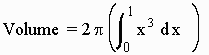
Consider rotating the region between the curve y = x2, the line x = 2 and the x -axis about the y-axis. If instead of taking a cross section perpendicular to the y-axis, we take a cross section perpendicular to the x-axis, and revolve it about the y-axis, we get a cylinder. Recall that the area of a cylinder is given by:
A = 2p r h
where r is the radius of the cylinder and h is the height of the cylinder. We can see that the radius is the x coordinate of the point on the curve, and the height is the y coordinate of the curve. Hence A(x) = 2pxy = 2px(x2)
Therefore the volume is given by
Example: Find the volume of revolution of the region bounded by the curves y = x2 + 2 and y = x + 4 about the y axis.
Solution:
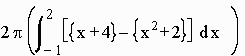
We draw the picture with a cross section perpendicular to the x-axis. The radius of the cylinder is x and the height is the difference of the y coordinates: (x + 4) - (x2 + 2). We solve for a and b. (x + 4) = (x2 + 2). x2 - x - 2 = 0 . (x - 2)(x + 1) = 0. So that a = -1 and b = 2. Hence the volume is equal to
Exercises:
Students will try:
A) y = x2 + x - 2, y = 0 about the y-axis
B) y = x2 - 3x + 2, y = 0 about the y-axis
C) x = 1 - y2 , x = 0 about the x-axis
D) y = xsqrt(1 + x3), y = 0, x = 0, y = 2 about the y-axis
E) x2 + (y - 1)2 = 1 about the y-axis
F) x2 + (y - 1)2 = 1 about the x-axis
G) y = x2 -2x + 1 about the line x = 3
H) y = 3x2 - 2x + 1 about the line y = 3