The First Derivative Test
I. Return Midterm II
II. Homework
III. The First Derivative Test
If f is a function, then f has a relative maximum at x = c if for all points a near c, f(c) > f(a), and f has a relative minimum at x = c if for all points a near c, f(c) < f(a).
Consider a relative maximum, we have that on the left, the function is increasing and on the right the function is decreasing. Similarly, for a relative minimum, on the right the function is decreasing and on the left the function is increasing.
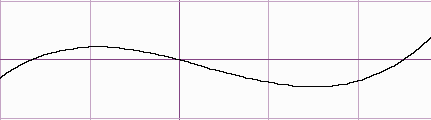
We can now state the first derivative test:
Let f'(c) = 0 then
1) If f'(x) changes from positive to negative, then f has a relative maximum at c.
2) If f'(x) changes from negative to positive, then f has a relative minimum at c.
Example:
Find and classify the relative extrema of
f(x) = x(1 - x)2/5
Solution
f'(x) = (1 - x)2/5 - 2/5 x(1 - x)-3/5 = 0
Now multiply by (1 - x)3/5
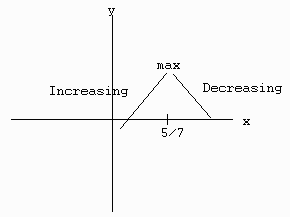
(1 - x) - 2/5 x = 0, 1 - 7/5 x = 0, x = 5/7 = 0.714
So there is a critical point at 5/7. To determine whether the critical point is a relative max, min or neither, choose a number just above and just below the critical value.
| x | 0.7 | 0.8 |
| f'(x) | 0.04 | -0.3 |
| Result | Increasing | Decreasing |
So we see that f is increasing to the left of the critical number and decreasing to the right of the critical number. Hence 5/7 is a relative maximum.
Exercise
A. Classify the relative extrema of
f(x)= x + 1/x
B. An electric current in amps is given by

where w is a nonzero constant. Find the maximum values of the current.