Composition and Inverses
I. Homework
II. Composition of Functions
Example: Sociologists in Holland determine that the number of people waiting in a water ride at an amusement park is given by
y = 1/50C2 + C + 2
where C is the temperature in degrees C. We have
C = 5/9 F + 160/9
To get a function of F we compose the two function:
y(C(F)) = (1/50)[5/9F + 160/9]2 + (5/9F + 160/9) + 2
Exercises:
If f(x) = 3x + 2 , g(x) = 2x2 + 1, h(x) = sqrt(x - 2), c(x) = 4
A) Find f(g(x))
B) Find f(h(x))
C) Find f(f(x))
D) Find h(c(x))
E)c(f(g(h(x))))
III. 1-1 Functions
A function f(x) is 1-1 if f(x) = f(b) implies that a = b
Example: If f(x) = 3x + 1 then 3a + 1 = 3b + 1 implies that 3a = 3b
hence a = b therefore f(x) is 1-1.
Example: If f(x) = x2 then a2 = b2 implies that a2 - b2 = 0 or that (a - b)(a + b) = 0 hence
a = b or a = -b. For example f(2) = f(-2) = 4. Hence f(x) is not 1-1.
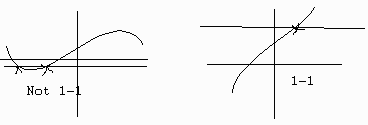
IV. Horizontal Line Test
If every horizontal line passes through f(x) at most once then f(x) is 1-1.
V. Inverse Functions
Definition: A function g(x) is an inverse of f(x) if
f(g(x)) = g(f(x)) = x
Example: The volume of a lake is modeled by the equation
V(t) = 1/125 h3
Show that the inverse is
h(N) = 5V1/3
We have h(V(h)) = 5(1/125h3)1/3 = 5/5h = h
and v(h(V)) = 1/125(5V1/3)3 = 1/125(125V) = V
VI) Step by Step Process for Finding the Inverse:
1) Interchange the variables
2) Solve for y
3) Write in terms of f-1(x)
Example:
f(x) = y = 3x3 - 5
1) x = 3y3 - 5
2) x - 5 = 3y3 , (x - 5)/3 = y3 , [(x - 5)/3]1/3
3) f-1(x) = [(x - 5)/3]1/3
VII) Graphing:
To graph an inverse we draw the y = x line and reflect the graph across this line.
This will be demonstrated in class.